 EN
EN  DE
DE 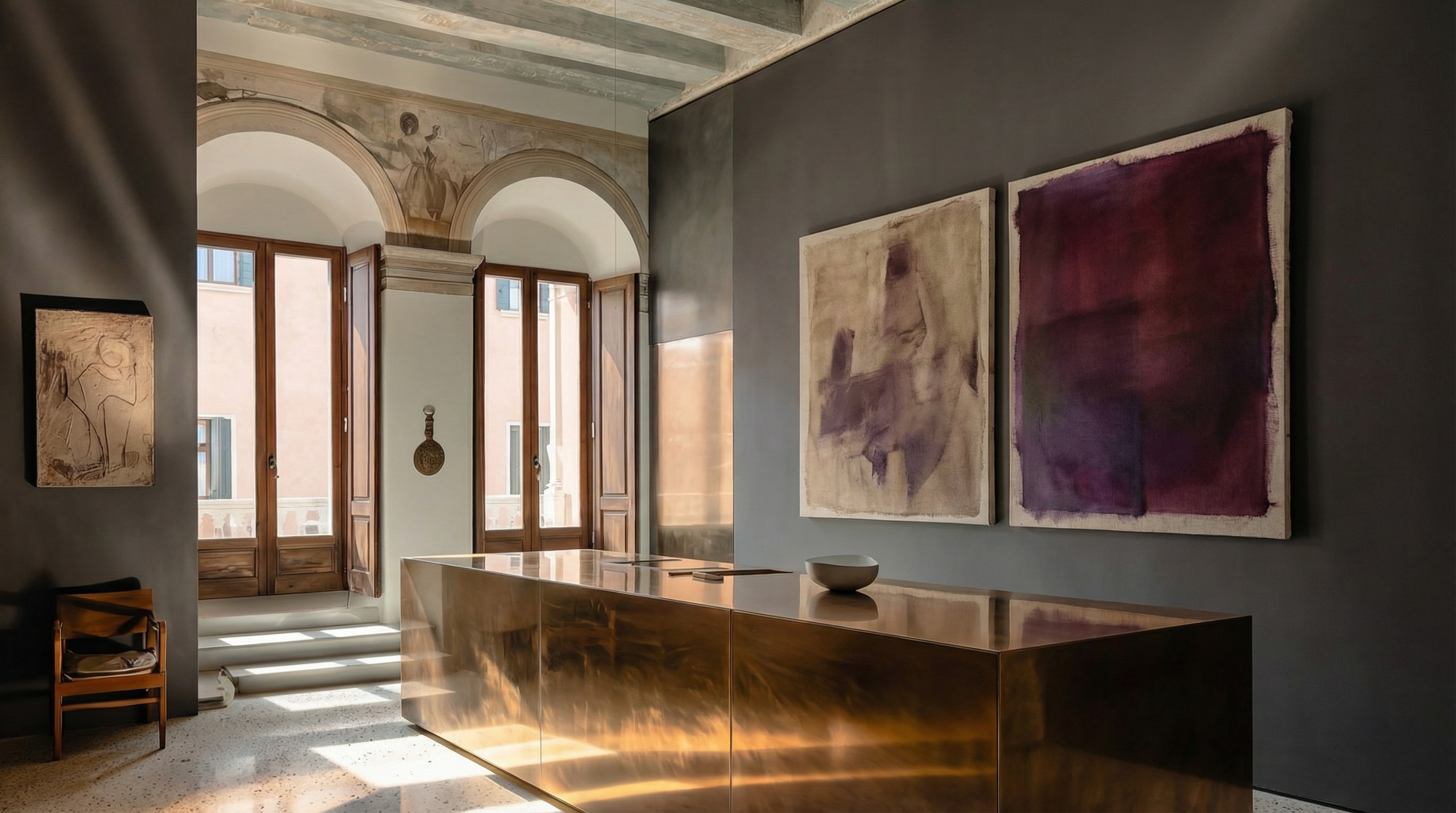
In 2025–2026, surrealism is not just returning because it is quietly redefining the entire visual language of contemporary art. This is no longer the historical surrealism of Salvador Dalí with its sharp theatrical symbolism and overt dream logic. The new surrealism is softer, more psychological, more cinematic, and deeply atmospheric. It does not shout, choosing instead to linger.
We are witnessing a profound shift toward what could be called post-digital surrealism, where the boundaries between reality, memory, imagination, and subconscious experience dissolve into one continuous emotional space. At the center of this revival are dream aesthetics, mystical imagery, symbolic layering, liminal spaces, strange beauty, and a new form of emotional melancholy that feels both intimate and universal.
The New Dream Language of Contemporary Art
"CONTEMPORARY SURREALISM DOES NOT CONSTRUCT VISUAL PARADOXES.
IT CONSTRUCTS EMOTIONAL STATES."
— THE CURATORIAL REVIEW
Traditional surrealism of the twentieth century, associated with artists like Dalí, René Magritte, and Max Ernst, was built on shock, paradox, and visual disruption. It often placed clearly recognizable objects into impossible compositions to challenge rational perception. The new surrealism is fundamentally different, discarding shock in favor of complete emotional immersion.
The image has become less of an object and more of an atmosphere, evoking a distinct feeling of being between worlds, between memory and imagination, or between presence and disappearance. This shift reflects a broader cultural transformation where visual culture is increasingly influenced by cinema, digital environments, algorithmic aesthetics, and immersive installations.
Dream aesthetics and the return of the interior landscape
One of the strongest elements of this movement is the return of dream aesthetics. Contemporary artists are increasingly drawing from sleep states, fragmented memory, symbolic associations, and subconscious emotional narratives. Unlike historical surrealism, where dreams were often interpreted as rigid symbolic puzzles, today’s dream imagery is more fluid and unresolved. It does not ask to be decoded because it simply asks to be felt.
This creates a visual language that is intentionally ambiguous, soft-edged, and emotionally open. In many ways, it mirrors the psychological condition of modern life itself, where constant digital stimulation creates fragmented attention and deeply layered emotional states that resist simple categorization.
The beauty and psychological power of in-betweenness
Another defining characteristic of contemporary surrealism is the fascination with liminal spaces. These are environments that feel suspended between realities, such as empty corridors, undefined interiors, transitional landscapes, fading architecture, and places without clear function or identity. Liminal aesthetics have become a dominant visual code across contemporary photography, painting, film, and digital art.
They evoke isolation, quiet tension, memory distortion, and emotional suspension. Unlike traditional surrealist dreamscapes, these spaces feel deeply familiar. They are not fantastical worlds but slightly shifted versions of reality itself, and this subtle distortion is precisely what makes them so psychologically powerful.
Sensuality, soft melancholy, and emotional storytelling
Modern surrealism is deeply influenced by cinema, borrowing heavily from film framing, lighting, narrative pacing, and emotional composition. Avant-garde directors have demonstrated that surrealism does not need to be loud or chaotic, as it can be quiet, sensual, and deeply unsettling at the same time. This cinematic influence has led to a new visual grammar where images feel like still frames from an unseen film, suggesting a narrative but never fully revealing it.
Unlike early surrealism, which often relied on confrontation and intellectual provocation, contemporary practice is more sensual and emotionally introspective. It explores soft melancholy, emotional distance, fragility, intimacy, and subconscious desire. There is often a feeling that something has just happened or is about to happen while remaining unseen, creating a tension between presence and absence that positions the viewer inside the environment rather than as a detached observer.
An emotional response to digital saturation
The return of surrealism is closely connected to the psychological condition of the digital era. In a world dominated by artificial intelligence, algorithmic imagery, and constant visual production, people are increasingly drawn to images that feel less controlled, less literal, and more emotionally open. Surrealism offers exactly that, allowing uncertainty to exist without resolution while creating space for imagination in a hyper-defined visual environment.
TODAY’S SURREALIST ARTISTS ARE NOT SIMPLY DEPICTING DREAMS.
THEY ARE BUILDING EMOTIONAL ARCHITECTURES.
The human figure often appears blurred, fragmented, displaced, or dissolved into the surrounding atmosphere, while objects lose their functional identity and become emotional symbols rather than physical things. Color palettes tend toward muted tones, hazy light, and soft gradients that enhance the sense of psychological distance, resulting in a visual world that feels both intimate and unreachable.
Ultimately, the new surrealism is not a revival of the past but a reconfiguration of how we perceive reality itself. It reflects a world where the boundaries between the digital and physical are no longer stable. Instead of trying to escape reality, contemporary surrealism reveals its hidden layers, showing that beneath the surface of everyday life there is always another emotional dimension quietly unfolding. Surrealism has become once again one of the most relevant visual languages of contemporary art, not because it is strange, but because it feels true.