 EN
EN  DE
DE 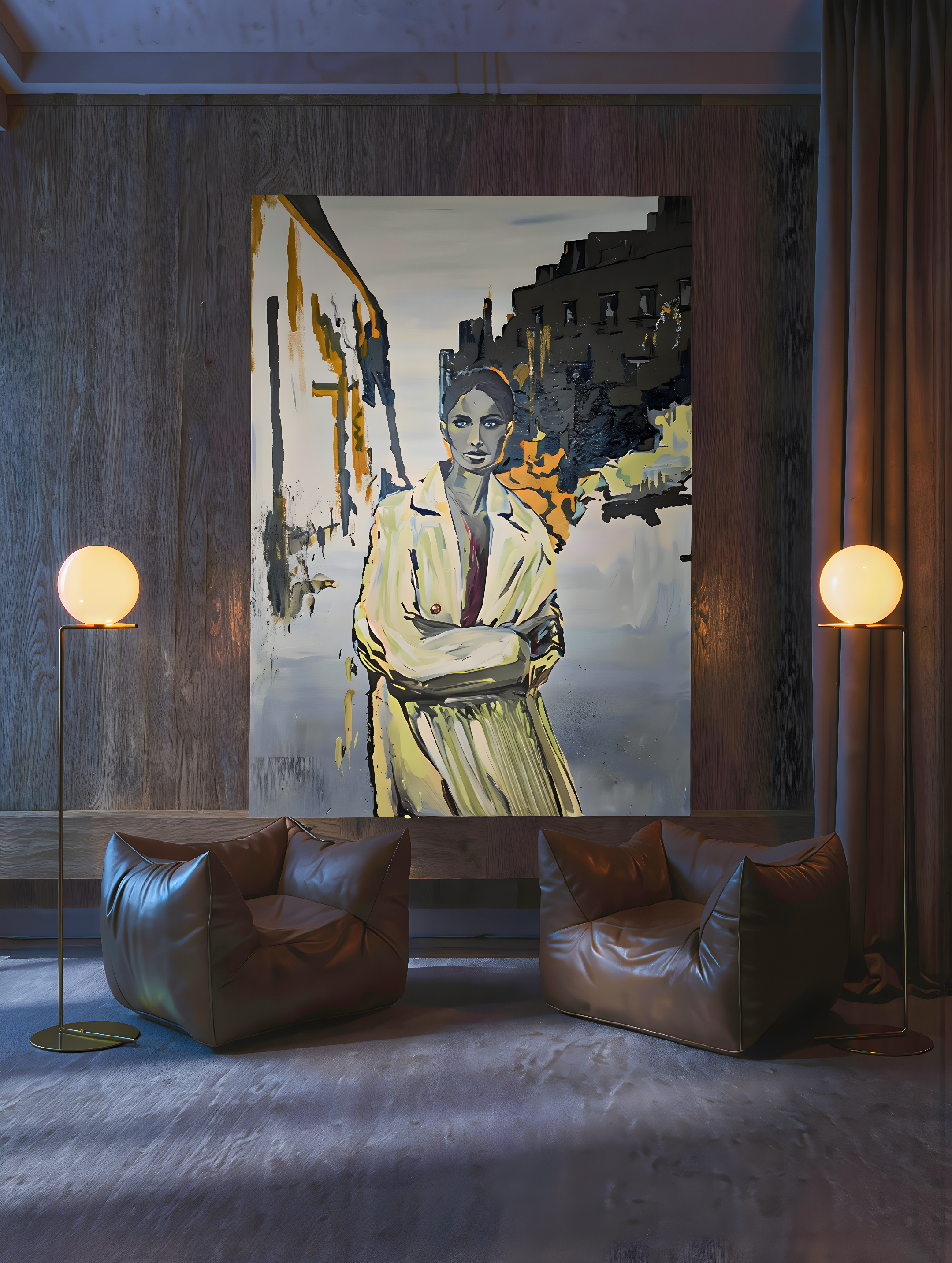
There is a specific moment when standing before a work of truly monumental scale that the body understands something the mind has not yet formulated. The painting is not merely on the wall because you find yourself completely inside it. This is not a metaphor but pure neuroscience.
Large-format art, which exceeds the human body in at least one dimension, fills peripheral vision entirely and cannot be taken in from a single fixed position. It operates on the nervous system in ways that are categorically different from works of conventional scale. This experience is not aesthetic appreciation at a distance, as it closely resembles immersion, a distinct state the brain enters when the boundaries between self and environment become temporarily permeable.
When Scale Becomes the Subject: The Neuroscience of Monumental Art
"I WANT TO MAKE THE VIEWER FEEL THAT THEY ARE CAUGHT WITHIN THE PICTURE,
NOT LOOKING AT IT FROM OUTSIDE."
— MARK ROTHKO
Rothko understood precisely what large-scale painting does to our perceptual system. When a work extends beyond the boundaries of central vision and begins to occupy the peripheral field, the brain shifts its processing modes. Peripheral vision is handled predominantly by the magnocellular pathway, a system tuned not for details and object recognition but for motion, spatial orientation, and, above all, emotional salience. It speaks directly to subcortical structures that regulate arousal and alertness. While a reproduction addresses only the fovea, the original challenges the entire nervous system.
How the brain registers dimensions before the mind decides
In studies of aesthetic experience using functional neuroimaging, works of monumental scale consistently activate the default mode network more intensely than smaller works of equivalent quality. This constellation of brain regions, associated with self-referential thought and personal meaning, pulls the system into direct contact with the world. Consequently, it creates the perfect conditions for self-transcendence, which is a temporary loosening of the boundaries of the self associated with deep experiences of awe.
Awe is a state with measurable physiological correlates, as it slows the heart rate, expands time perception, and produces a characteristic stillness of the body. It requires an encounter with something vast that cannot be immediately categorised. Monumental art creates this condition reliably. Visitors to spaces where large-format works are installed slow down noticeably and stop talking. They move and adjust their position, which is exactly how the body behaves in the presence of something that genuinely exceeds it.
The historical argument for immensity
The impulse toward monumental scale in art is as old as the desire to create meaning that outlasts the individual. The cave paintings at Altamira and Lascaux cover ceilings and walls because they were made for a space that was meant to be entered rather than simply viewed. The Sistine Chapel ceiling and the panoramic canvases of John Martin made it clear that scale was never a quantitative increase in ambition but a qualitative change in the nature of the encounter.
The twentieth century formalised this understanding. The Abstract Expressionists made size central to their practice for reasons that were explicitly perceptual. Barnett Newman, whose work "Vir Heroicus Sublimis" stretched 5.4 metres wide and was accompanied by a note requesting that viewers stand close, understood that meaning was physiological before it was intellectual. Clyfford Still spoke of wanting to free the viewer from the tyranny of the rectangular easel picture. The large canvas was a proposal for a completely different kind of encounter.
Artists at the limits of the body
Among living artists, several have built their entire practice around the psychological possibilities of extreme scale. Cy Twombly's late ceiling paintings at the Louvre turn the act of looking upward into something that recalls the Sistine Chapel. Anselm Kiefer works at a scale that is almost architectural, so his lead-weighted surfaces create environments rather than pictures. Walking into a room of major Kiefer paintings means entering a landscape that cannot be held at an aesthetic distance.
SCALE IS NOT SIZE.
IT IS THE RELATIONSHIP BETWEEN THE WORK AND THE BODY THAT STANDS BEFORE IT.
Julie Mehretu's large-scale paintings layer marks made over years into surfaces of extraordinary density. Only at this size can the temporal depth of the work be legible, allowing the viewer to sense the accumulation of time and decision-making. Similarly, the grids of Agnes Martin require their large format to produce the meditative perceptual field that is the actual subject of the work. At reproduction size they are merely diagrams, but at full scale they become true experiences.
What it means to live with monumental work
Collecting large-format art is a commitment of a completely different order, as it requires a willingness to organise the spaces of one's life around these works. A major large-format piece cannot be simply accommodated because it demands a genuine encounter. The room must be built for the work or the work chosen for the room, making the relationship between the art and the architecture a primary consideration. The work changes the space, and the space changes the work.
The neuropsychological argument for living with large-format art is ultimately a plea for sustained exposure to the experience of awe. Regular encounters with stimuli that exceed the current framework of the ego are associated with greater psychological flexibility, reduced rumination, and a more stable, grounded identity. A great work does not merely decorate a life but actively participates in it, serving as a permanent invitation to stand before something larger than yourself.